EXERCISE 2.1
Polynomials • 1 Questions
Question 1
Hint available
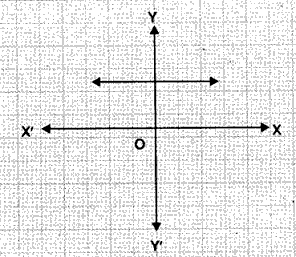
The graphs of y = p(x) are given in Fig. 2.10 below, for some p(x). Find the number of zeroes of p(x), in each case. Fig. 2.10
Key Idea
A real zero of a polynomial p(x) is a value of x for which p(x)=0. Graphically, this corresponds to the points where the curve y = p(x) meets the x‑axis. If the curve crosses the axis, the zero is of odd multiplicity; if it merely touches (is tangent to) the axis, the zero is of even multiplicity. Hence, the number of distinct real zeros equals the number of x‑intercepts of the graph.
Step-by-Step Solution
1. Observe the graph for each case (i), (ii) and (iii).
- Locate the points where the curve intersects the x‑axis (y = 0).
- Count each distinct intersection point.
- Whether the curve crosses or merely touches the axis does not change the count of distinct zeros; it only indicates the multiplicity of that zero.
2. Case (i): The curve cuts the x‑axis at three distinct points. Hence p(x) has 3 real zeros (each of multiplicity 1).
3. Case (ii): The curve touches the x‑axis at a single point and then moves away without crossing. This indicates a double (or even) root, but there is only 1 distinct real zero.
4. Case (iii): The curve never meets the x‑axis; it stays entirely above (or below) it. Therefore p(x) has no real zeros (all zeros, if any, are complex).
5. Conclusion: The number of zeroes of p(x) are:
- (i) 3
- (ii) 1
- (iii) 0
- Locate the points where the curve intersects the x‑axis (y = 0).
- Count each distinct intersection point.
- Whether the curve crosses or merely touches the axis does not change the count of distinct zeros; it only indicates the multiplicity of that zero.
2. Case (i): The curve cuts the x‑axis at three distinct points. Hence p(x) has 3 real zeros (each of multiplicity 1).
3. Case (ii): The curve touches the x‑axis at a single point and then moves away without crossing. This indicates a double (or even) root, but there is only 1 distinct real zero.
4. Case (iii): The curve never meets the x‑axis; it stays entirely above (or below) it. Therefore p(x) has no real zeros (all zeros, if any, are complex).
5. Conclusion: The number of zeroes of p(x) are:
- (i) 3
- (ii) 1
- (iii) 0