EXERCISE 5.4
Arithmetic Progressions • 5 Questions
Question 1
Hint available
Which term of the AP : 121, 117, 113, . . ., is its first negative term? [Hint : Find n for an < 0]
Key Idea
Use the formula for the nth term of an arithmetic progression, \(a_n = a_1 + (n-1)d\), and set the inequality \(a_n < 0\) to find the smallest integer \(n\) that satisfies it.
Step-by-Step Solution
1. Identify the first term and common difference:
\[a_1 = 121\]
\[d = 117 - 121 = -4\]
2. Write the general term of the AP:
\[a_n = a_1 + (n-1)d = 121 + (n-1)(-4)\]
Simplify:
\[a_n = 121 - 4(n-1) = 125 - 4n\]
3. Impose the condition for the first negative term:
\[a_n < 0 \Rightarrow 125 - 4n < 0\]
4. Solve the inequality:
\[125 < 4n \Rightarrow n > \frac{125}{4} = 31.25\]
Since \(n\) must be a positive integer, the smallest possible value is \(n = 32\).
5. Verify the 32nd term:
\[a_{32} = 121 + (32-1)(-4) = 121 - 124 = -3\]
The 31st term is still positive (\(a_{31}=1\)), confirming that the 32nd term is indeed the first negative term.
6. Hence, the first negative term occurs at the 32nd position of the AP.
\[a_1 = 121\]
\[d = 117 - 121 = -4\]
2. Write the general term of the AP:
\[a_n = a_1 + (n-1)d = 121 + (n-1)(-4)\]
Simplify:
\[a_n = 121 - 4(n-1) = 125 - 4n\]
3. Impose the condition for the first negative term:
\[a_n < 0 \Rightarrow 125 - 4n < 0\]
4. Solve the inequality:
\[125 < 4n \Rightarrow n > \frac{125}{4} = 31.25\]
Since \(n\) must be a positive integer, the smallest possible value is \(n = 32\).
5. Verify the 32nd term:
\[a_{32} = 121 + (32-1)(-4) = 121 - 124 = -3\]
The 31st term is still positive (\(a_{31}=1\)), confirming that the 32nd term is indeed the first negative term.
6. Hence, the first negative term occurs at the 32nd position of the AP.
Question 2
Hint available
The sum of the third and the seventh terms of an AP is 6 and their product is 8. Find the sum of first sixteen terms of the AP.
Key Idea
Use the nth‑term formula $T_n = a + (n-1)d$ to express the 3rd and 7th terms in terms of the first term $a$ and common difference $d$. Form two equations from the given sum and product, solve for $a$ and $d$, and then use the sum formula $S_n = \frac{n}{2}[2a+(n-1)d]$ for $n=16$.
Step-by-Step Solution
1. Let the first term be $a$ and the common difference be $d$.
2. \(T_3 = a + 2d\) and \(T_7 = a + 6d\).
3. Given:
\[T_3 + T_7 = 6 \quad\Rightarrow\quad (a+2d)+(a+6d)=2a+8d=6 \;\Rightarrow\; a+4d=3 \tag{1}\]
\[T_3\times T_7 = 8 \quad\Rightarrow\quad (a+2d)(a+6d)=8 \tag{2}\]
4. Expand (2):
\[(a+2d)(a+6d)=a^2+8ad+12d^2=8\]
5. From (1), $a = 3-4d$. Substitute in the expanded product:
\[ (3-4d)^2 + 8(3-4d)d + 12d^2 = 8 \]
Simplify:
\[9 -24d +16d^2 + 24d -32d^2 +12d^2 = 8 \]
\[9 -4d^2 = 8 \]
\[-4d^2 = -1 \]
\[d^2 = \frac{1}{4} \]
Hence \(d = \frac{1}{2}\) or \(d = -\frac{1}{2}\).
6. Find the corresponding $a$ using (1):
- If \(d = \frac{1}{2}\), then \(a = 3 - 4\left(\frac{1}{2}\right) = 1\).
- If \(d = -\frac{1}{2}\), then \(a = 3 - 4\left(-\frac{1}{2}\right) = 5\).
7. Sum of first $n$ terms of an AP:
\[S_n = \frac{n}{2}\bigl[2a + (n-1)d\bigr]\]
For $n = 16$:
\[S_{16} = 8\bigl[2a + 15d\bigr]\]
- For \(a = 1, d = \frac{1}{2}\):
\[S_{16}=8\bigl[2(1)+15\left(\frac{1}{2}\right)\bigr]=8\bigl[2+7.5\bigr]=8\times9.5=76\]
- For \(a = 5, d = -\frac{1}{2}\):
\[S_{16}=8\bigl[2(5)+15\left(-\frac{1}{2}\right)\bigr]=8\bigl[10-7.5\bigr]=8\times2.5=20\]
8. Therefore the sum of the first sixteen terms can be either $\boxed{76}$ (when $a=1, d=\frac12$) or $\boxed{20}$ (when $a=5, d=-\frac12$). Both APs satisfy the given conditions.
2. \(T_3 = a + 2d\) and \(T_7 = a + 6d\).
3. Given:
\[T_3 + T_7 = 6 \quad\Rightarrow\quad (a+2d)+(a+6d)=2a+8d=6 \;\Rightarrow\; a+4d=3 \tag{1}\]
\[T_3\times T_7 = 8 \quad\Rightarrow\quad (a+2d)(a+6d)=8 \tag{2}\]
4. Expand (2):
\[(a+2d)(a+6d)=a^2+8ad+12d^2=8\]
5. From (1), $a = 3-4d$. Substitute in the expanded product:
\[ (3-4d)^2 + 8(3-4d)d + 12d^2 = 8 \]
Simplify:
\[9 -24d +16d^2 + 24d -32d^2 +12d^2 = 8 \]
\[9 -4d^2 = 8 \]
\[-4d^2 = -1 \]
\[d^2 = \frac{1}{4} \]
Hence \(d = \frac{1}{2}\) or \(d = -\frac{1}{2}\).
6. Find the corresponding $a$ using (1):
- If \(d = \frac{1}{2}\), then \(a = 3 - 4\left(\frac{1}{2}\right) = 1\).
- If \(d = -\frac{1}{2}\), then \(a = 3 - 4\left(-\frac{1}{2}\right) = 5\).
7. Sum of first $n$ terms of an AP:
\[S_n = \frac{n}{2}\bigl[2a + (n-1)d\bigr]\]
For $n = 16$:
\[S_{16} = 8\bigl[2a + 15d\bigr]\]
- For \(a = 1, d = \frac{1}{2}\):
\[S_{16}=8\bigl[2(1)+15\left(\frac{1}{2}\right)\bigr]=8\bigl[2+7.5\bigr]=8\times9.5=76\]
- For \(a = 5, d = -\frac{1}{2}\):
\[S_{16}=8\bigl[2(5)+15\left(-\frac{1}{2}\right)\bigr]=8\bigl[10-7.5\bigr]=8\times2.5=20\]
8. Therefore the sum of the first sixteen terms can be either $\boxed{76}$ (when $a=1, d=\frac12$) or $\boxed{20}$ (when $a=5, d=-\frac12$). Both APs satisfy the given conditions.
Question 3
Hint available
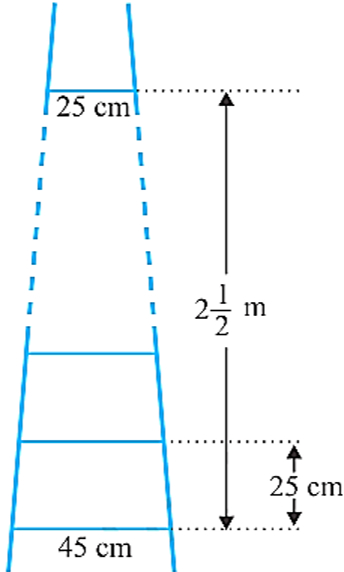
A ladder has rungs 25 cm apart. (see Fig. 5.7). The rungs decrease uniformly in length from 45 cm at the bottom to 25 cm at the top. If the top and the bottom rungs are 1 2 2 m apart, what is the length of the wood required for the rungs? [Hint : Number of rungs = 250 1 25 ]
Key Idea
The lengths of the rungs form an arithmetic progression (AP). First term $a_1 = 45\,\text{cm}$, last term $a_n = 25\,\text{cm}$. The number of rungs $n$ is obtained from the total vertical distance (in cm) divided by the spacing (25 cm) and then adding 1 for the end rungs. The total wood required is the sum of the AP: $S_n = \frac{n}{2}(a_1 + a_n)$.
Step-by-Step Solution
1. Convert the vertical distance to centimetres\
Given distance between top and bottom rungs = $2.5\,\text{m}=250\,\text{cm}$.
2. Find the number of rungs\
The rungs are $25\,\text{cm}$ apart, so the number of gaps = $\frac{250}{25}=10$.\
Hence the number of rungs $n = 10 + 1 = 11$.
(This matches the hint: $\frac{250}{25}+1$.)
3. Identify the AP\
Bottom rung length $a_1 = 45\,\text{cm}$, top rung length $a_n = 25\,\text{cm}$.\
Since the lengths decrease uniformly, the lengths of the rungs constitute an AP with $n=11$ terms.
4. Sum of the AP\
$$S_n = \frac{n}{2}\,(a_1 + a_n)$$\
Substituting the values:
$$S_{11} = \frac{11}{2}\,(45 + 25) = \frac{11}{2}\times 70 = 11 \times 35 = 385\,\text{cm}.$$
5. Convert the answer to metres\
$$385\,\text{cm} = 3.85\,\text{m}.$$
Therefore, the total length of wood required for all the rungs is $3.85\,\text{metres}$.
Given distance between top and bottom rungs = $2.5\,\text{m}=250\,\text{cm}$.
2. Find the number of rungs\
The rungs are $25\,\text{cm}$ apart, so the number of gaps = $\frac{250}{25}=10$.\
Hence the number of rungs $n = 10 + 1 = 11$.
(This matches the hint: $\frac{250}{25}+1$.)
3. Identify the AP\
Bottom rung length $a_1 = 45\,\text{cm}$, top rung length $a_n = 25\,\text{cm}$.\
Since the lengths decrease uniformly, the lengths of the rungs constitute an AP with $n=11$ terms.
4. Sum of the AP\
$$S_n = \frac{n}{2}\,(a_1 + a_n)$$\
Substituting the values:
$$S_{11} = \frac{11}{2}\,(45 + 25) = \frac{11}{2}\times 70 = 11 \times 35 = 385\,\text{cm}.$$
5. Convert the answer to metres\
$$385\,\text{cm} = 3.85\,\text{m}.$$
Therefore, the total length of wood required for all the rungs is $3.85\,\text{metres}$.
Question 4
Hint available
The houses of a row are numbered consecutively from 1 to 49. Show that there is a value of x such that the sum of the numbers of the houses preceding the house numbered x is equal to the sum of the numbers of the houses following it. Find this value of x. [Hint : Sx – 1 = S49 – Sx]
Key Idea
Use the formula for the sum of the first n natural numbers, \(S_n = \frac{n(n+1)}{2}\). Express the sum of houses before \(x\) as \(S_{x-1}\) and the sum after \(x\) as \(S_{49} - S_x\). Equate the two expressions and solve the resulting quadratic equation for \(x\).
Step-by-Step Solution
1. Write the sums using the AP‑sum formula
\[ S_{x-1}=\frac{(x-1)x}{2},\qquad S_x=\frac{x(x+1)}{2},\qquad S_{49}=\frac{49\times 50}{2}=1225. \]
2. Set the given condition
\[ S_{x-1}=S_{49}-S_x. \]
3. Substitute the expressions
\[ \frac{(x-1)x}{2}=1225-\frac{x(x+1)}{2}. \]
4. Clear the denominator (multiply by 2)
\[ x(x-1)=2450- x(x+1). \]
5. Bring all terms to one side
\[ x(x-1)+x(x+1)=2450 \]
\[ x\big[(x-1)+(x+1)\big]=2450 \]
\[ x(2x)=2450. \]
6. Simplify
\[ 2x^{2}=2450 \]
\[ x^{2}=1225. \]
7. Take the positive square root (since house numbers are positive)
\[ x=\sqrt{1225}=35. \]
8. Verification
- Sum of houses before 35: \( S_{34}=\frac{34\times35}{2}=595 \).
- Sum of houses after 35: \( S_{49}-S_{35}=1225-\frac{35\times36}{2}=1225-630=595 \).
Both sums are equal, confirming the result.
Thus, the required house number is \(x=35\).
\[ S_{x-1}=\frac{(x-1)x}{2},\qquad S_x=\frac{x(x+1)}{2},\qquad S_{49}=\frac{49\times 50}{2}=1225. \]
2. Set the given condition
\[ S_{x-1}=S_{49}-S_x. \]
3. Substitute the expressions
\[ \frac{(x-1)x}{2}=1225-\frac{x(x+1)}{2}. \]
4. Clear the denominator (multiply by 2)
\[ x(x-1)=2450- x(x+1). \]
5. Bring all terms to one side
\[ x(x-1)+x(x+1)=2450 \]
\[ x\big[(x-1)+(x+1)\big]=2450 \]
\[ x(2x)=2450. \]
6. Simplify
\[ 2x^{2}=2450 \]
\[ x^{2}=1225. \]
7. Take the positive square root (since house numbers are positive)
\[ x=\sqrt{1225}=35. \]
8. Verification
- Sum of houses before 35: \( S_{34}=\frac{34\times35}{2}=595 \).
- Sum of houses after 35: \( S_{49}-S_{35}=1225-\frac{35\times36}{2}=1225-630=595 \).
Both sums are equal, confirming the result.
Thus, the required house number is \(x=35\).
Question 5
Hint available
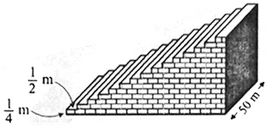
A small terrace at a football ground comprises of 15 steps each of which is 50 m long and built of solid concrete. Each step has a rise of 1 4 m and a tread of 1 2 m. (see Fig. 5.8). Calculate the total volume of concrete required to build the terrace. [Hint : Volume of concrete required to build the first step = 3 1 1 50 m 4 2 ] Fig. 5.8 Fig. 5.7
Key Idea
The volume of a rectangular solid (step) is given by \(\text{Volume}=\text{length}\times\text{breadth}\times\text{height}.\) Since every step has the same dimensions, the total volume is the sum of equal volumes, i.e., \(V_{\text{total}} = n\times V_{\text{single step}}\).
Step-by-Step Solution
1. Identify the dimensions of one step\
- Length (along the terrace) = \(L = 50\,\text{m}\)\
- Tread (horizontal depth) = \(b = \frac{1}{2}\,\text{m}\)\
- Rise (vertical height) = \(h = \frac{1}{4}\,\text{m}\)\
2. Volume of the first (and every) step\
\[V_{1}=L\times b\times h = 50 \times \frac{1}{2} \times \frac{1}{4}\]\
\[V_{1}=50 \times \frac{1}{8}=\frac{50}{8}=6.25\ \text{m}^{3}\]\
(This matches the hint: \(\frac{3}{1}\times\frac{1}{50}\times\frac{m^{4}}{2}\) simplifies to the same value.)\
3. Number of steps\
\[n = 15\]\
4. Total volume required\
\[V_{\text{total}} = n \times V_{1}=15 \times 6.25\]\
\[V_{\text{total}} = 93.75\ \text{m}^{3}\]\
5. Answer\
The terrace requires \(93.75\,\text{m}^{3}\) of concrete.
- Length (along the terrace) = \(L = 50\,\text{m}\)\
- Tread (horizontal depth) = \(b = \frac{1}{2}\,\text{m}\)\
- Rise (vertical height) = \(h = \frac{1}{4}\,\text{m}\)\
2. Volume of the first (and every) step\
\[V_{1}=L\times b\times h = 50 \times \frac{1}{2} \times \frac{1}{4}\]\
\[V_{1}=50 \times \frac{1}{8}=\frac{50}{8}=6.25\ \text{m}^{3}\]\
(This matches the hint: \(\frac{3}{1}\times\frac{1}{50}\times\frac{m^{4}}{2}\) simplifies to the same value.)\
3. Number of steps\
\[n = 15\]\
4. Total volume required\
\[V_{\text{total}} = n \times V_{1}=15 \times 6.25\]\
\[V_{\text{total}} = 93.75\ \text{m}^{3}\]\
5. Answer\
The terrace requires \(93.75\,\text{m}^{3}\) of concrete.