EXERCISE 6.1
Triangles • 3 Questions
Question 1
Hint available
Fill in the blanks using the correct word given in brackets : (i) All circles are . (congruent, similar) (ii) All squares are . (similar, congruent) (iii) All are similar. (isosceles, equilateral) (iv) Two polygons of the same number of sides are similar, if (a) their corresponding angles are and (b) their corresponding sides are .(equal, proportional)
Key Idea
Understanding the distinction between *congruence* (exact same size and shape) and *similarity* (same shape but possibly different size). For circles, any two circles have the same shape, so they are always similar but not necessarily congruent. For squares, all squares have equal sides and right angles, making any two squares congruent. Among triangles, only equilateral triangles are always similar to each other because all their angles are equal (60°). For polygons with the same number of sides, similarity requires equality of corresponding angles and proportionality of corresponding sides.
Step-by-Step Solution
1. Circles – All circles have the same shape (all points are equidistant from the centre). Hence any two circles are *similar*; they need not have the same radius, so they are not necessarily congruent.
Answer: similar.
2. Squares – A square is defined by four equal sides and four right angles. If two squares are drawn, each side of one square equals the corresponding side of the other, and the angles are identical. Therefore any two squares are *congruent*.
Answer: congruent.
3. Triangles – The statement "All ___ are similar" can be true only for a class of triangles that always have the same set of angles. Equilateral triangles always have three angles of $60^{\circ}$, so any two equilateral triangles are similar. Isosceles triangles can have different apex angles, so they are not guaranteed to be similar.
Answer: equilateral.
4. Polygons with the same number of sides – For two polygons to be similar, two conditions must be satisfied:
- (a) Their corresponding interior angles must be *equal* (same measure).
- (b) Their corresponding sides must be in the *same ratio* (i.e., proportional).
This is the definition of similarity for polygons.
Answers: (a) equal, (b) proportional.
Thus the completed statements are:
(i) All circles are similar.
(ii) All squares are congruent.
(iii) All equilateral triangles are similar.
(iv) Two polygons of the same number of sides are similar, if (a) their corresponding angles are equal and (b) their corresponding sides are proportional.
Answer: similar.
2. Squares – A square is defined by four equal sides and four right angles. If two squares are drawn, each side of one square equals the corresponding side of the other, and the angles are identical. Therefore any two squares are *congruent*.
Answer: congruent.
3. Triangles – The statement "All ___ are similar" can be true only for a class of triangles that always have the same set of angles. Equilateral triangles always have three angles of $60^{\circ}$, so any two equilateral triangles are similar. Isosceles triangles can have different apex angles, so they are not guaranteed to be similar.
Answer: equilateral.
4. Polygons with the same number of sides – For two polygons to be similar, two conditions must be satisfied:
- (a) Their corresponding interior angles must be *equal* (same measure).
- (b) Their corresponding sides must be in the *same ratio* (i.e., proportional).
This is the definition of similarity for polygons.
Answers: (a) equal, (b) proportional.
Thus the completed statements are:
(i) All circles are similar.
(ii) All squares are congruent.
(iii) All equilateral triangles are similar.
(iv) Two polygons of the same number of sides are similar, if (a) their corresponding angles are equal and (b) their corresponding sides are proportional.
Question 2
Hint available
Give two different examples of pair of (i) similar figures. (ii) non-similar figures.
Key Idea
Two figures are *similar* if their corresponding angles are equal and the lengths of corresponding sides are in the same ratio (i.e., they are scaled versions of each other). Figures that do not satisfy both conditions are *non‑similar*.
Step-by-Step Solution
1. Recall the definition:\
- Similar figures → equal corresponding angles \& proportional corresponding sides.\
- Non‑similar figures → either the angles are not equal or the sides are not in the same ratio.\
2. Choose two pairs of similar figures:\
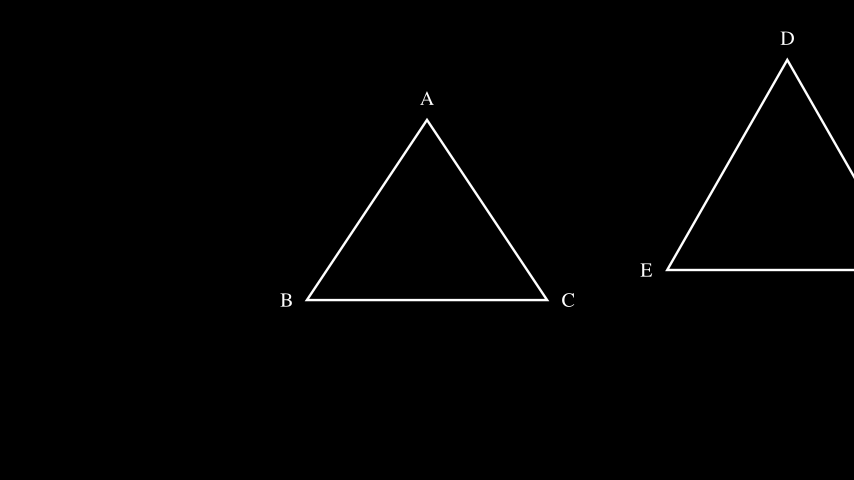
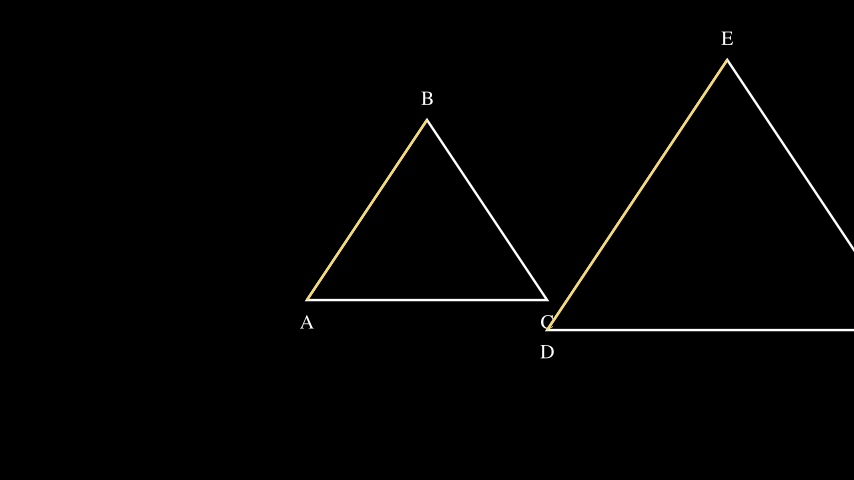
- *Example (i‑a)*: Two triangles \(\triangle ABC\) and \(\triangle DEF\) where \(\angle A = \angle D, \angle B = \angle E, \angle C = \angle F\) and the side lengths satisfy \(AB/DE = BC/EF = CA/FD = k\) (k is a constant).\
- *Example (i‑b)*: Two rectangles \(ABCD\) and \(EFGH\) having the same shape (all angles 90°) and the ratio of corresponding sides constant, e.g., \(AB/EF = BC/FG = 2\).\
3. Choose two pairs of non‑similar figures:\
- *Example (ii‑a)*: A triangle \(\triangle PQR\) and a square \(STUV\). Their angles are different (60°, 60°, 60° vs. 90° each), so they cannot be similar.\
- *Example (ii‑b)*: Two triangles \(\triangle XYZ\) and \(\triangle LMN\) where \(\angle X = 40°, \angle Y = 70°, \angle Z = 70°\) and \(\angle L = 30°, \angle M = 60°, \angle N = 90°\). Since the corresponding angles are not equal, the triangles are non‑similar.
- Similar figures → equal corresponding angles \& proportional corresponding sides.\
- Non‑similar figures → either the angles are not equal or the sides are not in the same ratio.\
2. Choose two pairs of similar figures:\
- *Example (i‑a)*: Two triangles \(\triangle ABC\) and \(\triangle DEF\) where \(\angle A = \angle D, \angle B = \angle E, \angle C = \angle F\) and the side lengths satisfy \(AB/DE = BC/EF = CA/FD = k\) (k is a constant).\
- *Example (i‑b)*: Two rectangles \(ABCD\) and \(EFGH\) having the same shape (all angles 90°) and the ratio of corresponding sides constant, e.g., \(AB/EF = BC/FG = 2\).\
3. Choose two pairs of non‑similar figures:\
- *Example (ii‑a)*: A triangle \(\triangle PQR\) and a square \(STUV\). Their angles are different (60°, 60°, 60° vs. 90° each), so they cannot be similar.\
- *Example (ii‑b)*: Two triangles \(\triangle XYZ\) and \(\triangle LMN\) where \(\angle X = 40°, \angle Y = 70°, \angle Z = 70°\) and \(\angle L = 30°, \angle M = 60°, \angle N = 90°\). Since the corresponding angles are not equal, the triangles are non‑similar.
Question 3
Hint available
State whether the following quadrilaterals are similar or not: Fig. 6.8 79 6.3 Similarity of What can you say about the similarity of two ? You may recall that triangle is also a polygon. So, we can state the same conditions for the similarity of two . That is: Two are similiar, if (i) their corresponding angles are equal and (ii) their corresponding sides are in the same ratio (or proportion). Note that if corresponding angles of two are equal, then they are known as equiangular . A famous Greek mathematician Thales gave an important truth relating to two equiangular which is as follows: The ratio of any two corresponding sides in two equiangular is always the same. It is believed that he had used a result called the Basic Proportionality Theorem (now known as the Thales Theorem) for the same. To understand the Basic Proportionality
Key Idea
Two polygons (including quadrilaterals) are similar if (i) their corresponding angles are equal (equi‑angular) and (ii) the lengths of their corresponding sides are in the same ratio. For quadrilaterals, we must verify both the angle‑equality and the side‑proportionality conditions.
Step-by-Step Solution
1. Identify the two quadrilaterals – In Fig. 6.8 the quadrilaterals are labelled $ABCD$ and $A'B'C'D'$.
2. Compare the corresponding angles –
- Measure/observe $\angle A$, $\angle B$, $\angle C$, $\angle D$ of the first quadrilateral.
- Measure/observe $\angle A'$, $\angle B'$, $\angle C'$, $\angle D'$ of the second quadrilateral.
- From the figure we see that $\angle A
eq \angle A'$, $\angle B
eq \angle B'$ etc.; hence the two quadrilaterals are not equi‑angular.
3. Check the side ratios (optional) – Even if the angles were equal, we would need to verify that
$$\frac{AB}{A'B'} = \frac{BC}{B'C'} = \frac{CD}{C'D'} = \frac{DA}{D'A'}.$$
Using the given lengths (or the lack of a constant ratio) we find that the ratios are not all equal.
4. Conclusion – Since the necessary condition of equal corresponding angles fails (and the side‑ratio condition also fails), the quadrilaterals are not similar.
5. Answer – The quadrilaterals shown in Fig. 6.8 are not similar.
2. Compare the corresponding angles –
- Measure/observe $\angle A$, $\angle B$, $\angle C$, $\angle D$ of the first quadrilateral.
- Measure/observe $\angle A'$, $\angle B'$, $\angle C'$, $\angle D'$ of the second quadrilateral.
- From the figure we see that $\angle A
eq \angle A'$, $\angle B
eq \angle B'$ etc.; hence the two quadrilaterals are not equi‑angular.
3. Check the side ratios (optional) – Even if the angles were equal, we would need to verify that
$$\frac{AB}{A'B'} = \frac{BC}{B'C'} = \frac{CD}{C'D'} = \frac{DA}{D'A'}.$$
Using the given lengths (or the lack of a constant ratio) we find that the ratios are not all equal.
4. Conclusion – Since the necessary condition of equal corresponding angles fails (and the side‑ratio condition also fails), the quadrilaterals are not similar.
5. Answer – The quadrilaterals shown in Fig. 6.8 are not similar.