Not the exact question you were looking for?
Paste your question to our Mathbee AI Mentor below to get an instant step-by-step solution.
Triangles
EXERCISE 6.2
CBSE_NCERT_TEXTBOOK
Grade 10
Question:
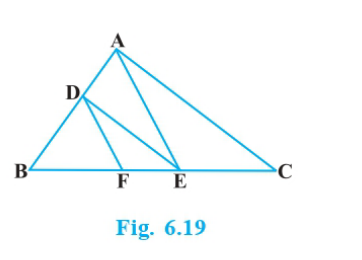
In Fig. 6.19, DE || AC and DF || AE. Prove that BF BE FE EC Fig. 6.18 Fig. 6.19 85
Step-by-Step Solution
Key Concept: Use the parallel lines to obtain similar triangles. From DE ∥ AC we get \(\triangle DFE \sim \triangle AEC\). From DF ∥ AE we get \(\triangle BDF \sim \triangle BAE\). The two similarity relations give the proportion \(\frac{BF}{BE}=\frac{DF}{AE}=\frac{FE}{EC}\), which after cross‑multiplication yields the required product relation.
1. Identify the similar triangles\
- Since \(DE \parallel AC\), the angles \(\angle DFE\) and \(\angle AEC\) are equal and \(\angle D EF\) and \(\angle A C E\) are equal. Hence\
$$\triangle DFE \sim \triangle AEC.$$\
- Since \(DF \parallel AE\), the angles \(\angle BDF\) and \(\angle BAE\) are equal and \(\angle BFD\) and \(\angle BEA\) are equal. Hence\
$$\triangle BDF \sim \triangle BAE.$$\
2. Write the proportionalities from the similar triangles\
- From \(\triangle DFE \sim \triangle AEC\):\
$$\frac{DF}{AE}=\frac{DE}{AC}=\frac{FE}{EC}\quad\Rightarrow\quad\frac{DF}{AE}=\frac{FE}{EC}. \tag{1}$$\
- From \(\triangle BDF \sim \triangle BAE\):\
$$\frac{BD}{BA}=\frac{BF}{BE}=\frac{DF}{AE}\quad\Rightarrow\quad\frac{BF}{BE}=\frac{DF}{AE}. \tag{2}$$\
3. Combine (1) and (2)\
From (2) we have \(\frac{BF}{BE}=\frac{DF}{AE}\). Using (1) to replace \(\frac{DF}{AE}\) we obtain\
$$\frac{BF}{BE}=\frac{FE}{EC}.$$\
4. Cross‑multiply\
$$BF\cdot EC = BE\cdot FE.$$\
Hence the required relation \(BF\,BE = FE\,EC\) is proved.
Conclusion: By establishing two pairs of similar triangles using the given parallel lines, we derived the proportion \(\frac{BF}{BE}=\frac{FE}{EC}\) which directly leads to the product equality \(BF\cdot BE = FE\cdot EC\).
- Since \(DE \parallel AC\), the angles \(\angle DFE\) and \(\angle AEC\) are equal and \(\angle D EF\) and \(\angle A C E\) are equal. Hence\
$$\triangle DFE \sim \triangle AEC.$$\
- Since \(DF \parallel AE\), the angles \(\angle BDF\) and \(\angle BAE\) are equal and \(\angle BFD\) and \(\angle BEA\) are equal. Hence\
$$\triangle BDF \sim \triangle BAE.$$\
2. Write the proportionalities from the similar triangles\
- From \(\triangle DFE \sim \triangle AEC\):\
$$\frac{DF}{AE}=\frac{DE}{AC}=\frac{FE}{EC}\quad\Rightarrow\quad\frac{DF}{AE}=\frac{FE}{EC}. \tag{1}$$\
- From \(\triangle BDF \sim \triangle BAE\):\
$$\frac{BD}{BA}=\frac{BF}{BE}=\frac{DF}{AE}\quad\Rightarrow\quad\frac{BF}{BE}=\frac{DF}{AE}. \tag{2}$$\
3. Combine (1) and (2)\
From (2) we have \(\frac{BF}{BE}=\frac{DF}{AE}\). Using (1) to replace \(\frac{DF}{AE}\) we obtain\
$$\frac{BF}{BE}=\frac{FE}{EC}.$$\
4. Cross‑multiply\
$$BF\cdot EC = BE\cdot FE.$$\
Hence the required relation \(BF\,BE = FE\,EC\) is proved.
Conclusion: By establishing two pairs of similar triangles using the given parallel lines, we derived the proportion \(\frac{BF}{BE}=\frac{FE}{EC}\) which directly leads to the product equality \(BF\cdot BE = FE\cdot EC\).
Correct Answer: BF·BE = FE·EC
Mathbee AI Mentor (Free Demo)
Confused by the solution? Ask the AI to explain a specific step, tell you where you went wrong, or break down the key trap in this question.