Not the exact question you were looking for?
Paste your question to our Mathbee AI Mentor below to get an instant step-by-step solution.
Triangles
EXERCISE 6.2
CBSE_NCERT_TEXTBOOK
Grade 10
Question:
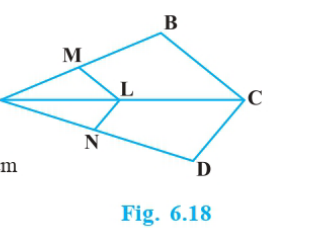
In Fig. 6.18, if LM || CB and LN || CD, prove that AM AN AB AD
Step-by-Step Solution
Key Concept: Use the parallelism to establish similarity of triangles $\triangle AML \sim \triangle ACB$ and $\triangle ANL \sim \triangle ADC$. From the similarity obtain the proportionality $\dfrac{AM}{AB}=\dfrac{AL}{AC}=\dfrac{AN}{AD}$, which leads to the required product relation.
1. Identify similar triangles\
- Since $LM \parallel CB$, the angle $\angle AML$ equals $\angle ACB$ (alternate interior angles) and $\angle ALM$ equals $\angle ABC$. Hence \[ \triangle AML \sim \triangle ACB. \]
- Since $LN \parallel CD$, the angle $\angle ANL$ equals $\angle ADC$ and $\angle ALN$ equals $\angle ACD$. Hence \[ \triangle ANL \sim \triangle ADC. \]
2. Write the corresponding side ratios\
From $\triangle AML \sim \triangle ACB$ we have\
\[ \frac{AM}{AB}=\frac{AL}{AC}=\frac{ML}{CB}. \tag{1} \]
From $\triangle ANL \sim \triangle ADC$ we have\
\[ \frac{AN}{AD}=\frac{AL}{AC}=\frac{NL}{DC}. \tag{2} \]
3. Equate the common ratio\
Both (1) and (2) contain the ratio $\dfrac{AL}{AC}$. Therefore\
\[ \frac{AM}{AB}=\frac{AN}{AD}. \]
4. Cross‑multiply\
\[ AM \cdot AD = AN \cdot AB. \]
5. Conclusion\
Hence, $AM \cdot AN = AB \cdot AD$, which is what had to be proved.
- Since $LM \parallel CB$, the angle $\angle AML$ equals $\angle ACB$ (alternate interior angles) and $\angle ALM$ equals $\angle ABC$. Hence \[ \triangle AML \sim \triangle ACB. \]
- Since $LN \parallel CD$, the angle $\angle ANL$ equals $\angle ADC$ and $\angle ALN$ equals $\angle ACD$. Hence \[ \triangle ANL \sim \triangle ADC. \]
2. Write the corresponding side ratios\
From $\triangle AML \sim \triangle ACB$ we have\
\[ \frac{AM}{AB}=\frac{AL}{AC}=\frac{ML}{CB}. \tag{1} \]
From $\triangle ANL \sim \triangle ADC$ we have\
\[ \frac{AN}{AD}=\frac{AL}{AC}=\frac{NL}{DC}. \tag{2} \]
3. Equate the common ratio\
Both (1) and (2) contain the ratio $\dfrac{AL}{AC}$. Therefore\
\[ \frac{AM}{AB}=\frac{AN}{AD}. \]
4. Cross‑multiply\
\[ AM \cdot AD = AN \cdot AB. \]
5. Conclusion\
Hence, $AM \cdot AN = AB \cdot AD$, which is what had to be proved.
Correct Answer: $AM \cdot AN = AB \cdot AD$
Mathbee AI Mentor (Free Demo)
Confused by the solution? Ask the AI to explain a specific step, tell you where you went wrong, or break down the key trap in this question.