Not the exact question you were looking for?
Paste your question to our Mathbee AI Mentor below to get an instant step-by-step solution.
Arithmetic Progressions
EXERCISE 5.4
CBSE_NCERT_TEXTBOOK
Grade 10
Question:
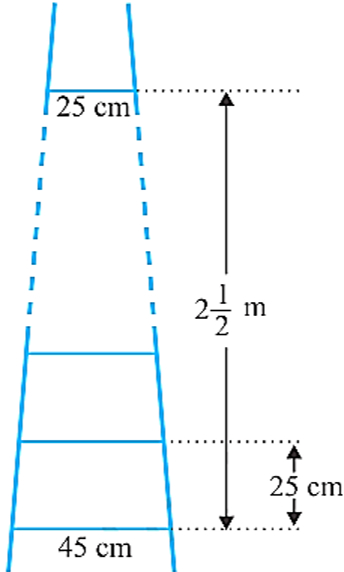
A ladder has rungs 25 cm apart. (see Fig. 5.7). The rungs decrease uniformly in length from 45 cm at the bottom to 25 cm at the top. If the top and the bottom rungs are 1 2 2 m apart, what is the length of the wood required for the rungs? [Hint : Number of rungs = 250 1 25 ]
Step-by-Step Solution
Key Concept: The lengths of the rungs form an arithmetic progression (AP). First term $a_1 = 45\,\text{cm}$, last term $a_n = 25\,\text{cm}$. The number of rungs $n$ is obtained from the total vertical distance (in cm) divided by the spacing (25 cm) and then adding 1 for the end rungs. The total wood required is the sum of the AP: $S_n = \frac{n}{2}(a_1 + a_n)$.
1. Convert the vertical distance to centimetres\
Given distance between top and bottom rungs = $2.5\,\text{m}=250\,\text{cm}$.
2. Find the number of rungs\
The rungs are $25\,\text{cm}$ apart, so the number of gaps = $\frac{250}{25}=10$.\
Hence the number of rungs $n = 10 + 1 = 11$.
(This matches the hint: $\frac{250}{25}+1$.)
3. Identify the AP\
Bottom rung length $a_1 = 45\,\text{cm}$, top rung length $a_n = 25\,\text{cm}$.\
Since the lengths decrease uniformly, the lengths of the rungs constitute an AP with $n=11$ terms.
4. Sum of the AP\
$$S_n = \frac{n}{2}\,(a_1 + a_n)$$\
Substituting the values:
$$S_{11} = \frac{11}{2}\,(45 + 25) = \frac{11}{2}\times 70 = 11 \times 35 = 385\,\text{cm}.$$
5. Convert the answer to metres\
$$385\,\text{cm} = 3.85\,\text{m}.$$
Therefore, the total length of wood required for all the rungs is $3.85\,\text{metres}$.
Given distance between top and bottom rungs = $2.5\,\text{m}=250\,\text{cm}$.
2. Find the number of rungs\
The rungs are $25\,\text{cm}$ apart, so the number of gaps = $\frac{250}{25}=10$.\
Hence the number of rungs $n = 10 + 1 = 11$.
(This matches the hint: $\frac{250}{25}+1$.)
3. Identify the AP\
Bottom rung length $a_1 = 45\,\text{cm}$, top rung length $a_n = 25\,\text{cm}$.\
Since the lengths decrease uniformly, the lengths of the rungs constitute an AP with $n=11$ terms.
4. Sum of the AP\
$$S_n = \frac{n}{2}\,(a_1 + a_n)$$\
Substituting the values:
$$S_{11} = \frac{11}{2}\,(45 + 25) = \frac{11}{2}\times 70 = 11 \times 35 = 385\,\text{cm}.$$
5. Convert the answer to metres\
$$385\,\text{cm} = 3.85\,\text{m}.$$
Therefore, the total length of wood required for all the rungs is $3.85\,\text{metres}$.
Correct Answer: 3.85 m
Mathbee AI Mentor (Free Demo)
Confused by the solution? Ask the AI to explain a specific step, tell you where you went wrong, or break down the key trap in this question.