Not the exact question you were looking for?
Paste your question to our Mathbee AI Mentor below to get an instant step-by-step solution.
Triangles
EXERCISE 6.3
CBSE_NCERT_TEXTBOOK
Grade 10
Question:
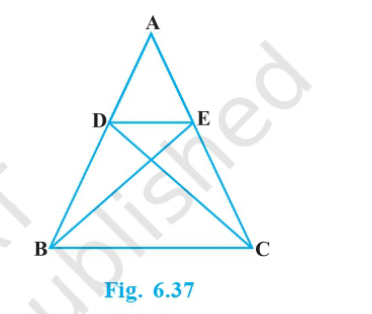
In Fig. 6.37, if ABE ACD, show that ADE ~ ABC.
Step-by-Step Solution
Key Concept: Congruent triangles \(\Delta ABE\) and \(\Delta ACD\) give equal corresponding sides \(AB = AC\) and \(AE = AD\). Hence both \(\Delta ABC\) and \(\Delta ADE\) are isosceles with vertex at \(A\) and have the same vertex angle \(\angle BAC\). Two triangles that are isosceles with equal vertex angles are similar (AA criterion).
1. Given congruence \(\Delta ABE \cong \Delta ACD\).
\[\begin{aligned}
AB &= AC \quad\text{(corresponding sides)}\\
AE &= AD \quad\text{(corresponding sides)}\\
\angle BAE &= \angle CAD \quad\text{(corresponding angles)}
\end{aligned}\]
2. Identify isosceles triangles
- From \(AB = AC\) we conclude that \(\Delta ABC\) is isosceles with vertex at \(A\).
- From \(AE = AD\) we conclude that \(\Delta ADE\) is also isosceles with vertex at \(A\).
3. Equality of the vertex angles
In \(\Delta ABC\) the vertex angle is \(\angle BAC\). In \(\Delta ADE\) the vertex angle is \(\angle DAE\).
Using the equality of the corresponding angles from step 1:
\[\angle DAE = \angle BAE + \angle CAD = \angle BAE + \angle BAE = \angle BAC.\]
Hence \(\angle DAE = \angle BAC\).
4. Apply AA similarity criterion
- Both triangles have the vertex angle equal: \(\angle DAE = \angle BAC\).
- Both are isosceles, therefore their base angles are equal:
\[\angle ADE = \angle ABC \quad\text{and}\quad \angle AED = \angle ACB.\]
Thus two angles of \(\Delta ADE\) are respectively equal to two angles of \(\Delta ABC\).
5. Conclusion
By the AA (Angle‑Angle) similarity criterion,
\[\Delta ADE \sim \Delta ABC.\]
Hence the required similarity is proved.
\[\begin{aligned}
AB &= AC \quad\text{(corresponding sides)}\\
AE &= AD \quad\text{(corresponding sides)}\\
\angle BAE &= \angle CAD \quad\text{(corresponding angles)}
\end{aligned}\]
2. Identify isosceles triangles
- From \(AB = AC\) we conclude that \(\Delta ABC\) is isosceles with vertex at \(A\).
- From \(AE = AD\) we conclude that \(\Delta ADE\) is also isosceles with vertex at \(A\).
3. Equality of the vertex angles
In \(\Delta ABC\) the vertex angle is \(\angle BAC\). In \(\Delta ADE\) the vertex angle is \(\angle DAE\).
Using the equality of the corresponding angles from step 1:
\[\angle DAE = \angle BAE + \angle CAD = \angle BAE + \angle BAE = \angle BAC.\]
Hence \(\angle DAE = \angle BAC\).
4. Apply AA similarity criterion
- Both triangles have the vertex angle equal: \(\angle DAE = \angle BAC\).
- Both are isosceles, therefore their base angles are equal:
\[\angle ADE = \angle ABC \quad\text{and}\quad \angle AED = \angle ACB.\]
Thus two angles of \(\Delta ADE\) are respectively equal to two angles of \(\Delta ABC\).
5. Conclusion
By the AA (Angle‑Angle) similarity criterion,
\[\Delta ADE \sim \Delta ABC.\]
Hence the required similarity is proved.
Correct Answer: Since \(\Delta ABE \cong \Delta ACD\) we have \(AB = AC\) and \(AE = AD\). Thus \(\Delta ABC\) and \(\Delta ADE\) are both isosceles with the same vertex angle \(\angle BAC = \angle DAE\). By AA criterion, \(\Delta ADE \sim \Delta ABC\).
Mathbee AI Mentor (Free Demo)
Confused by the solution? Ask the AI to explain a specific step, tell you where you went wrong, or break down the key trap in this question.