Not the exact question you were looking for?
Paste your question to our Mathbee AI Mentor below to get an instant step-by-step solution.
Triangles
EXERCISE 6.2
CBSE_NCERT_TEXTBOOK
Grade 10
Question:
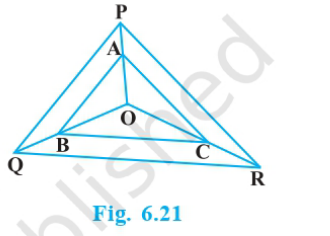
In Fig. 6.21, A, B and C are points on OP, OQ and OR respectively such that AB || PQ and AC || PR. Show that BC || QR.
Step-by-Step Solution
Key Concept: Use the similarity of triangles created by the given parallel lines (Basic Proportionality Theorem). From AB ∥ PQ we get similarity of ΔOAB and ΔOPQ; from AC ∥ PR we get similarity of ΔOAC and ΔOPR. Equating the corresponding ratios gives OB/OQ = OC/OR, which implies similarity of ΔOBC and ΔOQR, leading to BC ∥ QR.
1. Use the given parallelism AB ∥ PQ
- Since AB is parallel to PQ, the corresponding angles are equal:
$$\angle OAB = \angle OPQ \quad \text{and} \quad \angle OBA = \angle OQP.$$
- Hence, ΔOAB ∼ ΔOPQ (AA similarity).
- Therefore,
$$\frac{OA}{OP}=\frac{OB}{OQ}=\frac{AB}{PQ}\tag{1}$$
2. Use the given parallelism AC ∥ PR
- Similarly, because AC is parallel to PR,
$$\angle OAC = \angle OPR \quad \text{and} \quad \angle OCA = \angle ORP.$$
- Hence, ΔOAC ∼ ΔOPR (AA similarity).
- Consequently,
$$\frac{OA}{OP}=\frac{OC}{OR}=\frac{AC}{PR}\tag{2}$$
3. Equate the common ratio
- From (1) and (2) the first ratios are equal, so
$$\frac{OB}{OQ}=\frac{OC}{OR}\tag{3}$$
4. Show similarity of ΔOBC and ΔOQR
- In ΔOBC and ΔOQR we have:
- \(\angle BOC\) is common.
- From (3) the sides about this angle are in proportion:
$$\frac{OB}{OQ}=\frac{OC}{OR}.$$
- Hence, by SAS similarity, ΔOBC ∼ ΔOQR.
5. Conclude the required parallelism
- Corresponding angles of similar triangles are equal, therefore
$$\angle OBC = \angle OQR \quad \text{and} \quad \angle OCB = \angle ORQ.$$
- Equal corresponding angles imply that the sides opposite them are parallel, i.e.
$$BC \parallel QR.$$
Thus, BC is parallel to QR, as required.
- Since AB is parallel to PQ, the corresponding angles are equal:
$$\angle OAB = \angle OPQ \quad \text{and} \quad \angle OBA = \angle OQP.$$
- Hence, ΔOAB ∼ ΔOPQ (AA similarity).
- Therefore,
$$\frac{OA}{OP}=\frac{OB}{OQ}=\frac{AB}{PQ}\tag{1}$$
2. Use the given parallelism AC ∥ PR
- Similarly, because AC is parallel to PR,
$$\angle OAC = \angle OPR \quad \text{and} \quad \angle OCA = \angle ORP.$$
- Hence, ΔOAC ∼ ΔOPR (AA similarity).
- Consequently,
$$\frac{OA}{OP}=\frac{OC}{OR}=\frac{AC}{PR}\tag{2}$$
3. Equate the common ratio
- From (1) and (2) the first ratios are equal, so
$$\frac{OB}{OQ}=\frac{OC}{OR}\tag{3}$$
4. Show similarity of ΔOBC and ΔOQR
- In ΔOBC and ΔOQR we have:
- \(\angle BOC\) is common.
- From (3) the sides about this angle are in proportion:
$$\frac{OB}{OQ}=\frac{OC}{OR}.$$
- Hence, by SAS similarity, ΔOBC ∼ ΔOQR.
5. Conclude the required parallelism
- Corresponding angles of similar triangles are equal, therefore
$$\angle OBC = \angle OQR \quad \text{and} \quad \angle OCB = \angle ORQ.$$
- Equal corresponding angles imply that the sides opposite them are parallel, i.e.
$$BC \parallel QR.$$
Thus, BC is parallel to QR, as required.
Correct Answer: BC ∥ QR
Mathbee AI Mentor (Free Demo)
Confused by the solution? Ask the AI to explain a specific step, tell you where you went wrong, or break down the key trap in this question.