Not the exact question you were looking for?
Paste your question to our Mathbee AI Mentor below to get an instant step-by-step solution.
Polynomials
EXERCISE 2.1
CBSE_NCERT_TEXTBOOK
Grade 10
Question:
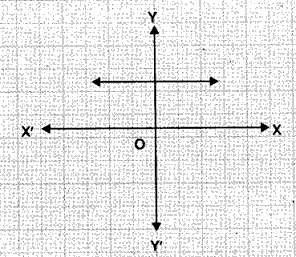
The graphs of y = p(x) are given in Fig. 2.10 below, for some p(x). Find the number of zeroes of p(x), in each case. Fig. 2.10
Step-by-Step Solution
Key Concept: A real zero of a polynomial p(x) is a value of x for which p(x)=0. Graphically, this corresponds to the points where the curve y = p(x) meets the x‑axis. If the curve crosses the axis, the zero is of odd multiplicity; if it merely touches (is tangent to) the axis, the zero is of even multiplicity. Hence, the number of distinct real zeros equals the number of x‑intercepts of the graph.
1. Observe the graph for each case (i), (ii) and (iii).
- Locate the points where the curve intersects the x‑axis (y = 0).
- Count each distinct intersection point.
- Whether the curve crosses or merely touches the axis does not change the count of distinct zeros; it only indicates the multiplicity of that zero.
2. Case (i): The curve cuts the x‑axis at three distinct points. Hence p(x) has 3 real zeros (each of multiplicity 1).
3. Case (ii): The curve touches the x‑axis at a single point and then moves away without crossing. This indicates a double (or even) root, but there is only 1 distinct real zero.
4. Case (iii): The curve never meets the x‑axis; it stays entirely above (or below) it. Therefore p(x) has no real zeros (all zeros, if any, are complex).
5. Conclusion: The number of zeroes of p(x) are:
- (i) 3
- (ii) 1
- (iii) 0
- Locate the points where the curve intersects the x‑axis (y = 0).
- Count each distinct intersection point.
- Whether the curve crosses or merely touches the axis does not change the count of distinct zeros; it only indicates the multiplicity of that zero.
2. Case (i): The curve cuts the x‑axis at three distinct points. Hence p(x) has 3 real zeros (each of multiplicity 1).
3. Case (ii): The curve touches the x‑axis at a single point and then moves away without crossing. This indicates a double (or even) root, but there is only 1 distinct real zero.
4. Case (iii): The curve never meets the x‑axis; it stays entirely above (or below) it. Therefore p(x) has no real zeros (all zeros, if any, are complex).
5. Conclusion: The number of zeroes of p(x) are:
- (i) 3
- (ii) 1
- (iii) 0
Correct Answer: (i) 3, (ii) 1, (iii) 0
Mathbee AI Mentor (Free Demo)
Confused by the solution? Ask the AI to explain a specific step, tell you where you went wrong, or break down the key trap in this question.