Not the exact question you were looking for?
Paste your question to our Mathbee AI Mentor below to get an instant step-by-step solution.
Circles
EXERCISE 10.2
CBSE_NCERT_TEXTBOOK
Grade 10
Question:
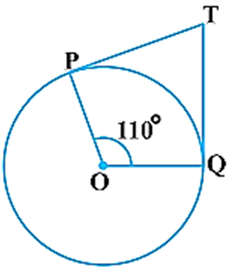
In Fig. 10.11, if TP and TQ are the two tangents to a circle with centre O so that POQ = 110°, then PTQ is equal to (A) 60° (B) 70° (C) 80° (D) 90°
Step-by-Step Solution
Key Concept: The radius drawn to the point of contact of a tangent is perpendicular to the tangent. Using the fact that the sum of interior angles of a quadrilateral is 360°, the angle between the two tangents from an external point equals 180° minus the central angle subtended by the points of contact.
1. Draw radii \(OP\) and \(OQ\) to the points of contact \(P\) and \(Q\).\
2. Since a tangent is perpendicular to the radius at the point of contact, we have\
\(\angle OPT = 90^{\circ}\) and \(\angle OQT = 90^{\circ}\).\
3. Consider quadrilateral \(OP TQ\). The sum of its interior angles is\
\[\angle POQ + \angle PTQ + \angle OPT + \angle OQT = 360^{\circ}.\]\
4. Substitute the right‑angle values:\
\[\angle POQ + \angle PTQ + 90^{\circ} + 90^{\circ} = 360^{\circ}.\]\
5. Simplify to obtain\
\[\angle PTQ = 360^{\circ} - 180^{\circ} - \angle POQ = 180^{\circ} - \angle POQ.\]\
6. Given \(\angle POQ = 110^{\circ}\),\
\[\angle PTQ = 180^{\circ} - 110^{\circ} = 70^{\circ}.\]\
7. Hence the required angle is \(70^{\circ}\), which corresponds to option (B).
2. Since a tangent is perpendicular to the radius at the point of contact, we have\
\(\angle OPT = 90^{\circ}\) and \(\angle OQT = 90^{\circ}\).\
3. Consider quadrilateral \(OP TQ\). The sum of its interior angles is\
\[\angle POQ + \angle PTQ + \angle OPT + \angle OQT = 360^{\circ}.\]\
4. Substitute the right‑angle values:\
\[\angle POQ + \angle PTQ + 90^{\circ} + 90^{\circ} = 360^{\circ}.\]\
5. Simplify to obtain\
\[\angle PTQ = 360^{\circ} - 180^{\circ} - \angle POQ = 180^{\circ} - \angle POQ.\]\
6. Given \(\angle POQ = 110^{\circ}\),\
\[\angle PTQ = 180^{\circ} - 110^{\circ} = 70^{\circ}.\]\
7. Hence the required angle is \(70^{\circ}\), which corresponds to option (B).
Correct Answer: B
Mathbee AI Mentor (Free Demo)
Confused by the solution? Ask the AI to explain a specific step, tell you where you went wrong, or break down the key trap in this question.