Not the exact question you were looking for?
Paste your question to our Mathbee AI Mentor below to get an instant step-by-step solution.
Some Applications Of Trigonometry
EXERCISE 9.1
CBSE_NCERT_TEXTBOOK
Grade 10
Question:
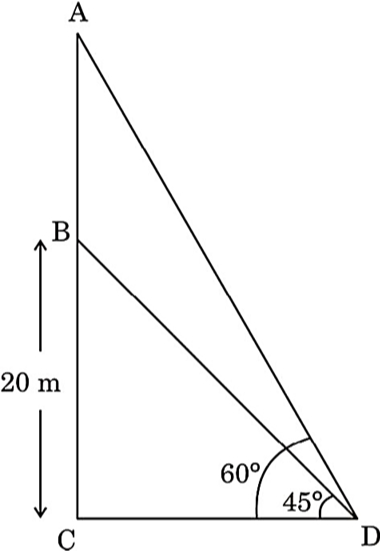
From a point on the ground, the angles of elevation of the bottom and the top of a transmission tower fixed at the top of a 20 m high building are 45° and 60° respectively. Find the height of the tower. Fig. 9.11 142
Step-by-Step Solution
Key Concept: Use the definition of tangent for angles of elevation in right‑angled triangles. First find the horizontal distance from the observation point to the building using the 45° elevation to the bottom of the tower, then use the 60° elevation to the top to obtain the total height and subtract the known building height.
1. Draw the diagram:\
- Let \(P\) be the point on the ground.\
- Let \(B\) be the foot of the building (ground).\
- Let \(C\) be the top of the building (bottom of the tower) with \(BC = 20\) m.\
- Let \(T\) be the top of the transmission tower, and \(CT = h\) (height of the tower to be found).\
- The horizontal distance \(PB = x\) is common for both observations.
2. Use the 45° angle of elevation to the bottom (point C):\
\[\tan 45^{\circ} = \frac{\text{opposite}}{\text{adjacent}} = \frac{BC}{PB} = \frac{20}{x}.\]
Since \(\tan 45^{\circ}=1\), we get \(x = 20\) m.
3. Use the 60° angle of elevation to the top (point T):\
The total height from ground to T is \(BC + CT = 20 + h\). Hence\
\[\tan 60^{\circ} = \frac{20 + h}{x} = \frac{20 + h}{20}.\]
Because \(\tan 60^{\circ}=\sqrt{3}\),\
\[\sqrt{3} = \frac{20 + h}{20} \quad\Rightarrow\quad 20 + h = 20\sqrt{3}.\]
4. Solve for \(h\):\
\[h = 20\sqrt{3} - 20 = 20(\sqrt{3} - 1)\text{ m}.\]
5. Numerical value (optional):\
\[\sqrt{3} \approx 1.732 \;\Rightarrow\; h \approx 20(1.732 - 1) = 20(0.732) \approx 14.64\text{ m}.\]
Thus the height of the transmission tower is \(20(\sqrt{3}-1)\) m (≈ 14.6 m).
- Let \(P\) be the point on the ground.\
- Let \(B\) be the foot of the building (ground).\
- Let \(C\) be the top of the building (bottom of the tower) with \(BC = 20\) m.\
- Let \(T\) be the top of the transmission tower, and \(CT = h\) (height of the tower to be found).\
- The horizontal distance \(PB = x\) is common for both observations.
2. Use the 45° angle of elevation to the bottom (point C):\
\[\tan 45^{\circ} = \frac{\text{opposite}}{\text{adjacent}} = \frac{BC}{PB} = \frac{20}{x}.\]
Since \(\tan 45^{\circ}=1\), we get \(x = 20\) m.
3. Use the 60° angle of elevation to the top (point T):\
The total height from ground to T is \(BC + CT = 20 + h\). Hence\
\[\tan 60^{\circ} = \frac{20 + h}{x} = \frac{20 + h}{20}.\]
Because \(\tan 60^{\circ}=\sqrt{3}\),\
\[\sqrt{3} = \frac{20 + h}{20} \quad\Rightarrow\quad 20 + h = 20\sqrt{3}.\]
4. Solve for \(h\):\
\[h = 20\sqrt{3} - 20 = 20(\sqrt{3} - 1)\text{ m}.\]
5. Numerical value (optional):\
\[\sqrt{3} \approx 1.732 \;\Rightarrow\; h \approx 20(1.732 - 1) = 20(0.732) \approx 14.64\text{ m}.\]
Thus the height of the transmission tower is \(20(\sqrt{3}-1)\) m (≈ 14.6 m).
Correct Answer: 20(√3 − 1) m \;\text{(≈ 14.6 m)}
Mathbee AI Mentor (Free Demo)
Confused by the solution? Ask the AI to explain a specific step, tell you where you went wrong, or break down the key trap in this question.