Not the exact question you were looking for?
Paste your question to our Mathbee AI Mentor below to get an instant step-by-step solution.
Triangles
EXERCISE 6.1
CBSE_NCERT_TEXTBOOK
Grade 10
Question:
Give two different examples of pair of (i) similar figures. (ii) non-similar figures.
Step-by-Step Solution
Key Concept: Two figures are *similar* if their corresponding angles are equal and the lengths of corresponding sides are in the same ratio (i.e., they are scaled versions of each other). Figures that do not satisfy both conditions are *non‑similar*.
1. Recall the definition:\
- Similar figures → equal corresponding angles \& proportional corresponding sides.\
- Non‑similar figures → either the angles are not equal or the sides are not in the same ratio.\
2. Choose two pairs of similar figures:\
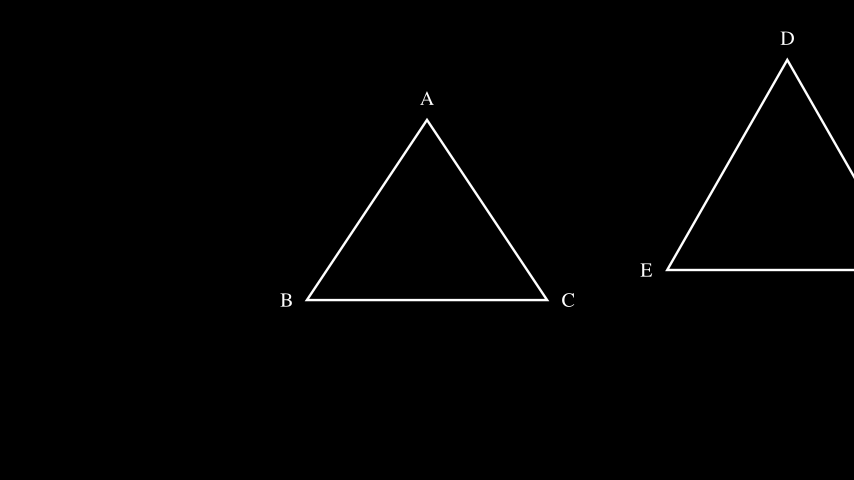
- *Example (i‑a)*: Two triangles \(\triangle ABC\) and \(\triangle DEF\) where \(\angle A = \angle D, \angle B = \angle E, \angle C = \angle F\) and the side lengths satisfy \(AB/DE = BC/EF = CA/FD = k\) (k is a constant).\
- *Example (i‑b)*: Two rectangles \(ABCD\) and \(EFGH\) having the same shape (all angles 90°) and the ratio of corresponding sides constant, e.g., \(AB/EF = BC/FG = 2\).\
3. Choose two pairs of non‑similar figures:\
- *Example (ii‑a)*: A triangle \(\triangle PQR\) and a square \(STUV\). Their angles are different (60°, 60°, 60° vs. 90° each), so they cannot be similar.\
- *Example (ii‑b)*: Two triangles \(\triangle XYZ\) and \(\triangle LMN\) where \(\angle X = 40°, \angle Y = 70°, \angle Z = 70°\) and \(\angle L = 30°, \angle M = 60°, \angle N = 90°\). Since the corresponding angles are not equal, the triangles are non‑similar.
- Similar figures → equal corresponding angles \& proportional corresponding sides.\
- Non‑similar figures → either the angles are not equal or the sides are not in the same ratio.\
2. Choose two pairs of similar figures:\
- *Example (i‑a)*: Two triangles \(\triangle ABC\) and \(\triangle DEF\) where \(\angle A = \angle D, \angle B = \angle E, \angle C = \angle F\) and the side lengths satisfy \(AB/DE = BC/EF = CA/FD = k\) (k is a constant).\
- *Example (i‑b)*: Two rectangles \(ABCD\) and \(EFGH\) having the same shape (all angles 90°) and the ratio of corresponding sides constant, e.g., \(AB/EF = BC/FG = 2\).\
3. Choose two pairs of non‑similar figures:\
- *Example (ii‑a)*: A triangle \(\triangle PQR\) and a square \(STUV\). Their angles are different (60°, 60°, 60° vs. 90° each), so they cannot be similar.\
- *Example (ii‑b)*: Two triangles \(\triangle XYZ\) and \(\triangle LMN\) where \(\angle X = 40°, \angle Y = 70°, \angle Z = 70°\) and \(\angle L = 30°, \angle M = 60°, \angle N = 90°\). Since the corresponding angles are not equal, the triangles are non‑similar.
Correct Answer: i) Similar figures: (a) Two triangles having equal corresponding angles and proportional sides, e.g., \(\triangle ABC\) and \(\triangle DEF\) with \(AB/DE = BC/EF = CA/FD\). (b) Two rectangles of the same shape with side‑length ratio constant, e.g., \(ABCD\) and \(EFGH\) with \(AB/EF = BC/FG = 2\).\
ii) Non‑similar figures: (a) A triangle and a square (different angles). (b) Two triangles with different sets of angles, e.g., \(\triangle XYZ\) (40°,70°,70°) and \(\triangle LMN\) (30°,60°,90°).
Mathbee AI Mentor (Free Demo)
Confused by the solution? Ask the AI to explain a specific step, tell you where you went wrong, or break down the key trap in this question.