Not the exact question you were looking for?
Paste your question to our Mathbee AI Mentor below to get an instant step-by-step solution.
Triangles
EXERCISE 6.3
CBSE_NCERT_TEXTBOOK
Grade 10
Question:
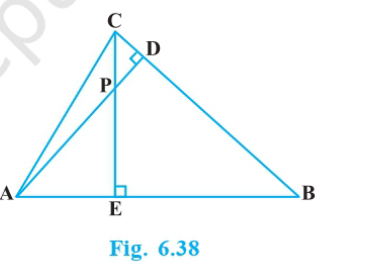
In Fig. 6.38, altitudes AD and CE of ABC intersect each other at the point P. Show that: (i) AEP ~ CDP (ii) ABD ~ CBE (iii) AEP ~ ADB (iv) PDC ~ BEC
Step-by-Step Solution
Key Concept: Altitudes are perpendicular to the opposite sides. Hence \(AD \perp BC\) and \(CE \perp AB\). Using the fact that two angles are equal (both being right angles) we can establish pairs of equal angles in the required triangles. Once two angles of one triangle are equal to two angles of another triangle, the triangles are similar (AA criterion).
1. Identify the right angles
- Since AD is an altitude, \(AD \perp BC\). Therefore \(\angle ADC = 90^{\circ}\) and \(\angle CDB = 90^{\circ}\).
- Since CE is an altitude, \(CE \perp AB\). Hence \(\angle CEA = 90^{\circ}\) and \(\angle BE C = 90^{\circ}\).
2. Angles at the orthocenter P
- The point P is the intersection of the two altitudes, so \(P\) lies on both AD and CE. Consequently, \(\angle APD\) and \(\angle EPC\) are also right angles because they are formed by the same lines AD and CE.
3. Proof of (i) \(\Delta AEP \sim \Delta CDP\)
- \(\angle AEP = 90^{\circ}\) (altitude CE) and \(\angle CDP = 90^{\circ}\) (altitude AD). Hence \(\angle AEP = \angle CDP\).
- The vertical angle at P gives \(\angle APE = \angle CPD\).
- With two equal angles, the triangles are similar by AA.
4. Proof of (ii) \(\Delta ABD \sim \Delta CBE\)
- \(\angle ABD = \angle CBE = 90^{\circ}\) (both are right angles as D and E are feet of the altitudes).
- The acute angle at B is common to both triangles: \(\angle BAD = \angle B C E\) because they are complementary to the same angle \(\angle ABC\). (Alternatively, note that \(\angle BAD\) and \(\angle B C E\) are the remaining angles of the two right‑angled triangles sharing side \(AB\) and \(BC\)).
- Hence two angles are equal, giving similarity by AA.
5. Proof of (iii) \(\Delta AEP \sim \Delta ADB\)
- \(\angle AEP = 90^{\circ}\) and \(\angle ADB = 90^{\circ}\) (both are right angles).
- The acute angle at A is common: \(\angle APE = \angle DAB\) because they are the complements of the same angle \(\angle BAC\) in the right‑angled triangles.
- Therefore the two triangles are similar (AA).
6. Proof of (iv) \(\Delta PDC \sim \Delta BEC\)
- \(\angle PDC = 90^{\circ}\) and \(\angle BEC = 90^{\circ}\) (right angles).
- The other acute angle at C is common: \(\angle PCD = \angle B C E\) (both are complements of \(\angle ACB\)).
- Hence the triangles are similar by AA.
7. Consequences of the similarity
- From (i) we obtain \(\frac{AE}{CD}=\frac{AP}{CP}=\frac{EP}{DP}\).
- From (ii) we obtain \(\frac{AB}{CB}=\frac{AD}{CE}=\frac{BD}{BE}\).
- From (iii) we obtain \(\frac{AE}{AD}=\frac{AP}{AB}=\frac{EP}{DB}\).
- From (iv) we obtain \(\frac{PD}{BE}=\frac{DC}{EC}=\frac{PC}{BC}\).
Thus all four required similarity relations are established using only the right‑angle property of the altitudes and the AA similarity criterion.
- Since AD is an altitude, \(AD \perp BC\). Therefore \(\angle ADC = 90^{\circ}\) and \(\angle CDB = 90^{\circ}\).
- Since CE is an altitude, \(CE \perp AB\). Hence \(\angle CEA = 90^{\circ}\) and \(\angle BE C = 90^{\circ}\).
2. Angles at the orthocenter P
- The point P is the intersection of the two altitudes, so \(P\) lies on both AD and CE. Consequently, \(\angle APD\) and \(\angle EPC\) are also right angles because they are formed by the same lines AD and CE.
3. Proof of (i) \(\Delta AEP \sim \Delta CDP\)
- \(\angle AEP = 90^{\circ}\) (altitude CE) and \(\angle CDP = 90^{\circ}\) (altitude AD). Hence \(\angle AEP = \angle CDP\).
- The vertical angle at P gives \(\angle APE = \angle CPD\).
- With two equal angles, the triangles are similar by AA.
4. Proof of (ii) \(\Delta ABD \sim \Delta CBE\)
- \(\angle ABD = \angle CBE = 90^{\circ}\) (both are right angles as D and E are feet of the altitudes).
- The acute angle at B is common to both triangles: \(\angle BAD = \angle B C E\) because they are complementary to the same angle \(\angle ABC\). (Alternatively, note that \(\angle BAD\) and \(\angle B C E\) are the remaining angles of the two right‑angled triangles sharing side \(AB\) and \(BC\)).
- Hence two angles are equal, giving similarity by AA.
5. Proof of (iii) \(\Delta AEP \sim \Delta ADB\)
- \(\angle AEP = 90^{\circ}\) and \(\angle ADB = 90^{\circ}\) (both are right angles).
- The acute angle at A is common: \(\angle APE = \angle DAB\) because they are the complements of the same angle \(\angle BAC\) in the right‑angled triangles.
- Therefore the two triangles are similar (AA).
6. Proof of (iv) \(\Delta PDC \sim \Delta BEC\)
- \(\angle PDC = 90^{\circ}\) and \(\angle BEC = 90^{\circ}\) (right angles).
- The other acute angle at C is common: \(\angle PCD = \angle B C E\) (both are complements of \(\angle ACB\)).
- Hence the triangles are similar by AA.
7. Consequences of the similarity
- From (i) we obtain \(\frac{AE}{CD}=\frac{AP}{CP}=\frac{EP}{DP}\).
- From (ii) we obtain \(\frac{AB}{CB}=\frac{AD}{CE}=\frac{BD}{BE}\).
- From (iii) we obtain \(\frac{AE}{AD}=\frac{AP}{AB}=\frac{EP}{DB}\).
- From (iv) we obtain \(\frac{PD}{BE}=\frac{DC}{EC}=\frac{PC}{BC}\).
Thus all four required similarity relations are established using only the right‑angle property of the altitudes and the AA similarity criterion.
Correct Answer: (i) \(\Delta AEP \sim \Delta CDP\) (ii) \(\Delta ABD \sim \Delta CBE\) (iii) \(\Delta AEP \sim \Delta ADB\) (iv) \(\Delta PDC \sim \Delta BEC\) – each follows from two equal angles as shown in the step‑wise solution.
Mathbee AI Mentor (Free Demo)
Confused by the solution? Ask the AI to explain a specific step, tell you where you went wrong, or break down the key trap in this question.