Not the exact question you were looking for?
Paste your question to our Mathbee AI Mentor below to get an instant step-by-step solution.
Triangles
EXERCISE 6.2
CBSE_NCERT_TEXTBOOK
Grade 10
Question:
In Fig. 6.17, (i) and (ii), DE || BC. Find EC in (i) and AD in (ii). Fig. 6.17
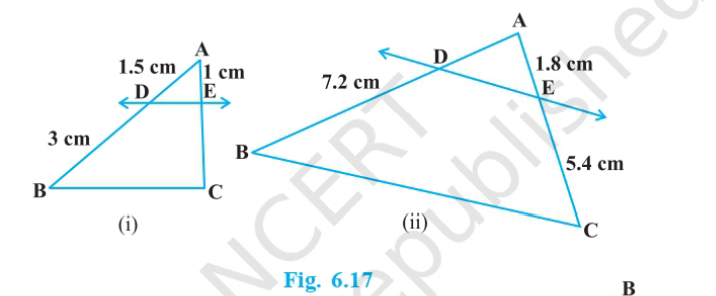
Step-by-Step Solution
Key Concept: Use the Basic Proportionality Theorem (Thales theorem): If a line drawn through a triangle is parallel to one side, it divides the other two sides proportionally. Hence, for DE ∥ BC, \(\frac{AD}{AB}=\frac{AE}{AC}=\frac{DE}{BC}\).
### (i) Find \(EC\)
1. Given: \(AB = 12\,\text{cm},\; AD = 4\,\text{cm},\; AC = 9\,\text{cm}\).
2. Since \(DE \parallel BC\), by the Basic Proportionality Theorem,
$$\frac{AD}{AB}=\frac{AE}{AC}.$$
3. Substitute the known values:
$$\frac{4}{12}=\frac{AE}{9}\;\Rightarrow\;AE = \frac{4}{12}\times 9 = 3\,\text{cm}.$$
4. On side \(AC\), \(AE + EC = AC\). Hence,
$$EC = AC - AE = 9 - 3 = 6\,\text{cm}.$$
5. Answer: \(EC = 6\,\text{cm}\).
### (ii) Find \(AD\)
1. Given: \(AB = 12\,\text{cm},\; AC = 9\,\text{cm},\; EC = 6\,\text{cm}\).
2. First find \(AE\):
$$AE = AC - EC = 9 - 6 = 3\,\text{cm}.$$
3. Again, using the Basic Proportionality Theorem,
$$\frac{AD}{AB}=\frac{AE}{AC}.$$
4. Substitute the known values:
$$\frac{AD}{12}=\frac{3}{9}\;\Rightarrow\;AD = \frac{3}{9}\times 12 = 4\,\text{cm}.$$
5. Answer: \(AD = 4\,\text{cm}\).
1. Given: \(AB = 12\,\text{cm},\; AD = 4\,\text{cm},\; AC = 9\,\text{cm}\).
2. Since \(DE \parallel BC\), by the Basic Proportionality Theorem,
$$\frac{AD}{AB}=\frac{AE}{AC}.$$
3. Substitute the known values:
$$\frac{4}{12}=\frac{AE}{9}\;\Rightarrow\;AE = \frac{4}{12}\times 9 = 3\,\text{cm}.$$
4. On side \(AC\), \(AE + EC = AC\). Hence,
$$EC = AC - AE = 9 - 3 = 6\,\text{cm}.$$
5. Answer: \(EC = 6\,\text{cm}\).
### (ii) Find \(AD\)
1. Given: \(AB = 12\,\text{cm},\; AC = 9\,\text{cm},\; EC = 6\,\text{cm}\).
2. First find \(AE\):
$$AE = AC - EC = 9 - 6 = 3\,\text{cm}.$$
3. Again, using the Basic Proportionality Theorem,
$$\frac{AD}{AB}=\frac{AE}{AC}.$$
4. Substitute the known values:
$$\frac{AD}{12}=\frac{3}{9}\;\Rightarrow\;AD = \frac{3}{9}\times 12 = 4\,\text{cm}.$$
5. Answer: \(AD = 4\,\text{cm}\).
Correct Answer: EC = 6 cm (in part (i)); AD = 4 cm (in part (ii))
Mathbee AI Mentor (Free Demo)
Confused by the solution? Ask the AI to explain a specific step, tell you where you went wrong, or break down the key trap in this question.