Not the exact question you were looking for?
Paste your question to our Mathbee AI Mentor below to get an instant step-by-step solution.
Circles
EXERCISE 10.2
CBSE_NCERT_TEXTBOOK
Grade 10
Question:
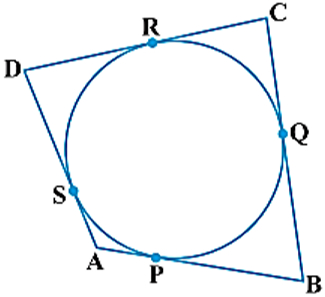
A quadrilateral ABCD is drawn to circumscribe a circle (see Fig. 10.12). Prove that AB + CD = AD + BC Fig. 10.12 Fig. 10.13
Step-by-Step Solution
Key Concept: For a quadrilateral that circumscribes a circle, the two tangents drawn from any external point to the circle are equal in length. Using the equal tangent lengths from the four vertices, express each side of the quadrilateral as a sum of two tangent segments and then compare the sums.
1. Identify points of tangency\
Let the circle touch the sides \(AB, BC, CD, DA\) at points \(P, Q, R, S\) respectively (as shown in Fig. 10.12).\
2. Use the tangent‑segment theorem\
From a point outside a circle, the two tangent segments drawn to the circle are equal. Hence,\
\[\begin{aligned}
AP &= AS \quad\text{(tangents from A)}\\
BP &= BQ \quad\text{(tangents from B)}\\
CQ &= CR \quad\text{(tangents from C)}\\
DR &= DS \quad\text{(tangents from D)}
\end{aligned}\]
3. Express each side as a sum of two tangent segments\
\[\begin{aligned}
AB &= AP + PB \\
BC &= BQ + QC \\
CD &= CR + RD \\
AD &= AS + SD
\end{aligned}\]
4. Form the sum \(AB + CD\)\
\[\begin{aligned}
AB + CD &= (AP + PB) + (CR + RD) \\
&= AP + PB + CR + RD
\end{aligned}\]
5. Replace the equal tangent lengths using step 2:\
\[\begin{aligned}
AP &= AS,\
PB &= BQ,\
CR &= CQ,\
RD &= DS
\end{aligned}\]
Substituting,\
\[\begin{aligned}
AB + CD &= AS + BQ + CQ + DS \\
&= (AS + DS) + (BQ + CQ) \\
&= AD + BC
\end{aligned}\]
6. Conclusion\
Hence, for a quadrilateral that circumscribes a circle, \(\boxed{AB + CD = AD + BC}\). This result is known as the *Pitot theorem* for tangential quadrilaterals.
Let the circle touch the sides \(AB, BC, CD, DA\) at points \(P, Q, R, S\) respectively (as shown in Fig. 10.12).\
2. Use the tangent‑segment theorem\
From a point outside a circle, the two tangent segments drawn to the circle are equal. Hence,\
\[\begin{aligned}
AP &= AS \quad\text{(tangents from A)}\\
BP &= BQ \quad\text{(tangents from B)}\\
CQ &= CR \quad\text{(tangents from C)}\\
DR &= DS \quad\text{(tangents from D)}
\end{aligned}\]
3. Express each side as a sum of two tangent segments\
\[\begin{aligned}
AB &= AP + PB \\
BC &= BQ + QC \\
CD &= CR + RD \\
AD &= AS + SD
\end{aligned}\]
4. Form the sum \(AB + CD\)\
\[\begin{aligned}
AB + CD &= (AP + PB) + (CR + RD) \\
&= AP + PB + CR + RD
\end{aligned}\]
5. Replace the equal tangent lengths using step 2:\
\[\begin{aligned}
AP &= AS,\
PB &= BQ,\
CR &= CQ,\
RD &= DS
\end{aligned}\]
Substituting,\
\[\begin{aligned}
AB + CD &= AS + BQ + CQ + DS \\
&= (AS + DS) + (BQ + CQ) \\
&= AD + BC
\end{aligned}\]
6. Conclusion\
Hence, for a quadrilateral that circumscribes a circle, \(\boxed{AB + CD = AD + BC}\). This result is known as the *Pitot theorem* for tangential quadrilaterals.
Correct Answer: AB + CD = AD + BC
Mathbee AI Mentor (Free Demo)
Confused by the solution? Ask the AI to explain a specific step, tell you where you went wrong, or break down the key trap in this question.