Not the exact question you were looking for?
Paste your question to our Mathbee AI Mentor below to get an instant step-by-step solution.
Triangles
EXERCISE 6.3
CBSE_NCERT_TEXTBOOK
Grade 10
Question:
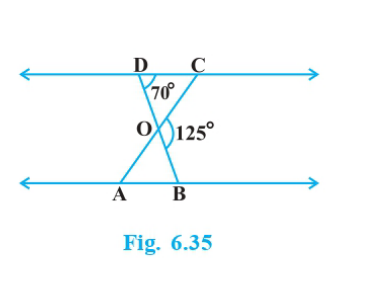
In Fig. 6.35, ODC ~ OBA, BOC = 125° and CDO = 70°. Find DOC, DCO and OAB.
Step-by-Step Solution
Key Concept: Use the angle–angle (AA) similarity of the two triangles. The similarity gives a one‑to‑one correspondence of the angles: ∠ODC ↔ ∠OAB, ∠OCD ↔ ∠OBA and ∠DOC ↔ ∠BOA. The given angle ∠BOC is split by the ray OD into ∠DOC and the given angle ∠CDO, allowing us to compute ∠DOC. Then the sum of angles in Δ ODC gives ∠DCO, and by similarity ∠OAB = ∠DCO.
1. Identify the correspondence of the similar triangles\
Since Δ ODC ~ Δ OBA, the vertices correspond as follows:\
\[ O \leftrightarrow O,\quad D \leftrightarrow A,\quad C \leftrightarrow B \]\
Hence\
\[\begin{aligned}
\angle ODC &= \angle OAB,\\
\angle OCD &= \angle OBA,\\
\angle DOC &= \angle BOA.
\end{aligned}\]\
2. Use the given angle at O\
The ray OD lies inside the angle \(\angle BOC\). Therefore\
\[\angle BOC = \angle DOC + \angle CDO.\]\
Substituting the known values gives\
\[125^{\circ}=\angle DOC + 70^{\circ}\]\
\[\Rightarrow \angle DOC = 125^{\circ} - 70^{\circ}=55^{\circ}.\]\
3. Find the remaining angle of Δ ODC\
In any triangle the sum of the interior angles is \(180^{\circ}\). Thus for Δ ODC\
\[\angle ODC + \angle DCO + \angle DOC = 180^{\circ}.\]\
Substituting \(\angle ODC = 70^{\circ}\) and \(\angle DOC = 55^{\circ}\) gives\
\[70^{\circ}+\angle DCO+55^{\circ}=180^{\circ}\]\
\[\Rightarrow \angle DCO = 180^{\circ}-125^{\circ}=55^{\circ}.\]\
4. Obtain \(\angle OAB\) from similarity\
From step 1, \(\angle OAB = \angle DCO\). Hence\
\[\angle OAB = 55^{\circ}.\]\
5. Summary of the required angles\
\[\angle DOC = 55^{\circ},\quad \angle DCO = 55^{\circ},\quad \angle OAB = 55^{\circ}.\]
Since Δ ODC ~ Δ OBA, the vertices correspond as follows:\
\[ O \leftrightarrow O,\quad D \leftrightarrow A,\quad C \leftrightarrow B \]\
Hence\
\[\begin{aligned}
\angle ODC &= \angle OAB,\\
\angle OCD &= \angle OBA,\\
\angle DOC &= \angle BOA.
\end{aligned}\]\
2. Use the given angle at O\
The ray OD lies inside the angle \(\angle BOC\). Therefore\
\[\angle BOC = \angle DOC + \angle CDO.\]\
Substituting the known values gives\
\[125^{\circ}=\angle DOC + 70^{\circ}\]\
\[\Rightarrow \angle DOC = 125^{\circ} - 70^{\circ}=55^{\circ}.\]\
3. Find the remaining angle of Δ ODC\
In any triangle the sum of the interior angles is \(180^{\circ}\). Thus for Δ ODC\
\[\angle ODC + \angle DCO + \angle DOC = 180^{\circ}.\]\
Substituting \(\angle ODC = 70^{\circ}\) and \(\angle DOC = 55^{\circ}\) gives\
\[70^{\circ}+\angle DCO+55^{\circ}=180^{\circ}\]\
\[\Rightarrow \angle DCO = 180^{\circ}-125^{\circ}=55^{\circ}.\]\
4. Obtain \(\angle OAB\) from similarity\
From step 1, \(\angle OAB = \angle DCO\). Hence\
\[\angle OAB = 55^{\circ}.\]\
5. Summary of the required angles\
\[\angle DOC = 55^{\circ},\quad \angle DCO = 55^{\circ},\quad \angle OAB = 55^{\circ}.\]
Correct Answer: ∠DOC = 55°, ∠DCO = 55°, ∠OAB = 55°
Mathbee AI Mentor (Free Demo)
Confused by the solution? Ask the AI to explain a specific step, tell you where you went wrong, or break down the key trap in this question.