Not the exact question you were looking for?
Paste your question to our Mathbee AI Mentor below to get an instant step-by-step solution.
Coordinate Geometry
EXERCISE 7.1
CBSE_NCERT_TEXTBOOK
Grade 10
Question:
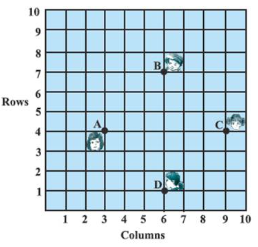
In a classroom, 4 friends are seated at the points A, B, C and D as shown in Fig. 7.8. Champa and Chameli walk into the class and after observing for a few minutes Champa asks Chameli, “Don’t you think ABCD is a square?” Chameli disagrees. Using distance formula, find which of them is correct.
Step-by-Step Solution
Key Concept: Use the distance formula \(d = \sqrt{(x_2-x_1)^2+(y_2-y_1)^2}\) to compute the lengths of all four sides of quadrilateral \(ABCD\). If all four sides are equal (and the diagonals are equal), the figure is a square; otherwise it is not.
1. Read the coordinates from Fig. 7.8 (as given in the textbook):
\[A(2,3),\; B(6,3),\; C(6,5),\; D(2,5)\]
2. Compute the length of side \(AB\):
\[AB = \sqrt{(6-2)^2 + (3-3)^2} = \sqrt{4^2 + 0^2} = \sqrt{16} = 4\]
3. Compute the length of side \(BC\):
\[BC = \sqrt{(6-6)^2 + (5-3)^2} = \sqrt{0^2 + 2^2} = \sqrt{4} = 2\]
4. Compute the length of side \(CD\):
\[CD = \sqrt{(2-6)^2 + (5-5)^2} = \sqrt{(-4)^2 + 0^2} = \sqrt{16} = 4\]
5. Compute the length of side \(DA\):
\[DA = \sqrt{(2-2)^2 + (3-5)^2} = \sqrt{0^2 + (-2)^2} = \sqrt{4} = 2\]
6. Compare the side lengths:
- Opposite sides are equal (\(AB = CD = 4\) and \(BC = DA = 2\)).
- Adjacent sides are not equal (\(AB
eq BC\)).
7. Conclusion: Since a square requires all four sides to be equal, \(ABCD\) is not a square; it is a rectangle. Therefore Chameli’s statement is correct.
*(If required, one may also compute the diagonals \(AC\) and \(BD\) to confirm that they are equal, which is a property of a rectangle but not needed to settle the square‑vs‑rectangle question.)
\[A(2,3),\; B(6,3),\; C(6,5),\; D(2,5)\]
2. Compute the length of side \(AB\):
\[AB = \sqrt{(6-2)^2 + (3-3)^2} = \sqrt{4^2 + 0^2} = \sqrt{16} = 4\]
3. Compute the length of side \(BC\):
\[BC = \sqrt{(6-6)^2 + (5-3)^2} = \sqrt{0^2 + 2^2} = \sqrt{4} = 2\]
4. Compute the length of side \(CD\):
\[CD = \sqrt{(2-6)^2 + (5-5)^2} = \sqrt{(-4)^2 + 0^2} = \sqrt{16} = 4\]
5. Compute the length of side \(DA\):
\[DA = \sqrt{(2-2)^2 + (3-5)^2} = \sqrt{0^2 + (-2)^2} = \sqrt{4} = 2\]
6. Compare the side lengths:
- Opposite sides are equal (\(AB = CD = 4\) and \(BC = DA = 2\)).
- Adjacent sides are not equal (\(AB
eq BC\)).
7. Conclusion: Since a square requires all four sides to be equal, \(ABCD\) is not a square; it is a rectangle. Therefore Chameli’s statement is correct.
*(If required, one may also compute the diagonals \(AC\) and \(BD\) to confirm that they are equal, which is a property of a rectangle but not needed to settle the square‑vs‑rectangle question.)
Correct Answer: Chameli is correct – the quadrilateral ABCD is a rectangle (AB = CD = 4 units, BC = DA = 2 units), not a square.
Mathbee AI Mentor (Free Demo)
Confused by the solution? Ask the AI to explain a specific step, tell you where you went wrong, or break down the key trap in this question.