Not the exact question you were looking for?
Paste your question to our Mathbee AI Mentor below to get an instant step-by-step solution.
Triangles
EXERCISE 6.3
CBSE_NCERT_TEXTBOOK
Grade 10
Question:
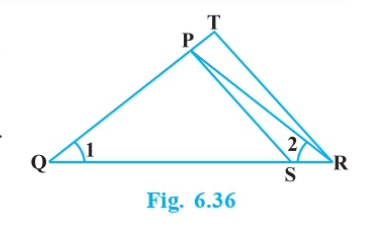
In Fig. 6.36, QR QT QS PR and 1 = 2. Show that PQS ~ TQR.
Step-by-Step Solution
Key Concept: Use the SAS (Side‑Angle‑Side) similarity criterion: if two sides of one triangle are proportional to two sides of another triangle and the included angles are equal, the triangles are similar.
1. Identify the given equalities
- QR = QT ⇒ \(\frac{QR}{QT}=1\)
- QS = PR ⇒ \(\frac{QS}{PR}=1\)
- ∠1 = ∠2 (the angle between the pairs of sides mentioned above).
2. Write the ratios of the corresponding sides
From the equalities we have
$$\frac{QR}{QT}=\frac{QS}{PR}=1.$$
Hence the two pairs of sides are in the same ratio.
3. Locate the included angles
- In ΔTQR the included angle between QR and QT is ∠1.
- In ΔPQS the included angle between PR and PS is ∠2.
Given that ∠1 = ∠2, the included angles of the two triangles are equal.
4. Apply SAS similarity
Since
$$\frac{QR}{QT}=\frac{QS}{PR}\quad\text{and}\quad \angle 1 = \angle 2,$$
by the SAS criterion, the triangles ΔTQR and ΔPQS are similar.
5. State the result
Therefore, \(\Delta PQS \sim \Delta TQR\).
Consequently, the corresponding sides are in proportion:
$$\frac{PQ}{TQ}=\frac{PS}{TR}=\frac{QS}{QR}.$$
- QR = QT ⇒ \(\frac{QR}{QT}=1\)
- QS = PR ⇒ \(\frac{QS}{PR}=1\)
- ∠1 = ∠2 (the angle between the pairs of sides mentioned above).
2. Write the ratios of the corresponding sides
From the equalities we have
$$\frac{QR}{QT}=\frac{QS}{PR}=1.$$
Hence the two pairs of sides are in the same ratio.
3. Locate the included angles
- In ΔTQR the included angle between QR and QT is ∠1.
- In ΔPQS the included angle between PR and PS is ∠2.
Given that ∠1 = ∠2, the included angles of the two triangles are equal.
4. Apply SAS similarity
Since
$$\frac{QR}{QT}=\frac{QS}{PR}\quad\text{and}\quad \angle 1 = \angle 2,$$
by the SAS criterion, the triangles ΔTQR and ΔPQS are similar.
5. State the result
Therefore, \(\Delta PQS \sim \Delta TQR\).
Consequently, the corresponding sides are in proportion:
$$\frac{PQ}{TQ}=\frac{PS}{TR}=\frac{QS}{QR}.$$
Correct Answer: ΔPQS ~ ΔTQR
Mathbee AI Mentor (Free Demo)
Confused by the solution? Ask the AI to explain a specific step, tell you where you went wrong, or break down the key trap in this question.