Not the exact question you were looking for?
Paste your question to our Mathbee AI Mentor below to get an instant step-by-step solution.
Triangles
EXERCISE 6.3
CBSE_NCERT_TEXTBOOK
Grade 10
Question:
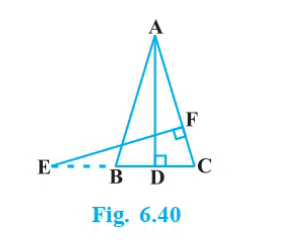
In Fig. 6.40, E is a point on side CB produced of an isosceles triangle ABC with AB = AC. If AD BC and EF AC, prove that ABD ~ ECF.
Step-by-Step Solution
Key Concept: Use the fact that in an isosceles triangle the base angles are equal (∠ABC = ∠BCA). Both triangles ABD and ECF are right‑angled (∠ADB = 90° and ∠EFC = 90°). Since E lies on the extension of CB, the angle at C of ΔECF equals the base angle at B of ΔABC. Hence two corresponding angles are equal, giving similarity.
1. Base‑angle property: In the isosceles triangle \(\triangle ABC\) with \(AB = AC\), the base angles are equal, i.e.\[ \angle ABC = \angle BCA. \tag{1}\]
2. Right angles:\
- AD is drawn perpendicular to BC, therefore \(\angle ADB = 90^{\circ}.\)\
- EF is drawn perpendicular to AC, and since \(CF\) lies on AC, \(\angle EFC = 90^{\circ}.\)\
Hence \[ \angle ADB = \angle EFC = 90^{\circ}. \tag{2}\]
3. Relation of the other angles:\
- Because E lies on the extension of CB, the line \(EC\) is the same straight line as \(CB\). Thus\[ \angle ECF = \angle BCA. \tag{3}\]
- Similarly, \(BD\) is a part of \(BC\), so\[ \angle ABD = \angle ABC. \tag{4}\]
4. Use (1), (3) and (4): From (1) we have \(\angle ABC = \angle BCA\). Using (3) and (4) this gives\[ \angle ABD = \angle ECF. \tag{5}\]
5. Two angles equal: From (2) and (5) we have\[ \angle ADB = \angle EFC \quad\text{and}\quad \angle ABD = \angle ECF. \]
Therefore the two triangles \(\triangle ABD\) and \(\triangle ECF\) have two equal corresponding angles.
6. Conclusion: By the AA criterion, the triangles are similar:
\[ \boxed{\triangle ABD \sim \triangle ECF}. \]
7. Consequences (optional): From the similarity we may also write the proportion of corresponding sides:
\[ \frac{AB}{EC}=\frac{AD}{EF}=\frac{BD}{CF}. \]
This relation can be used for further calculations if required.
2. Right angles:\
- AD is drawn perpendicular to BC, therefore \(\angle ADB = 90^{\circ}.\)\
- EF is drawn perpendicular to AC, and since \(CF\) lies on AC, \(\angle EFC = 90^{\circ}.\)\
Hence \[ \angle ADB = \angle EFC = 90^{\circ}. \tag{2}\]
3. Relation of the other angles:\
- Because E lies on the extension of CB, the line \(EC\) is the same straight line as \(CB\). Thus\[ \angle ECF = \angle BCA. \tag{3}\]
- Similarly, \(BD\) is a part of \(BC\), so\[ \angle ABD = \angle ABC. \tag{4}\]
4. Use (1), (3) and (4): From (1) we have \(\angle ABC = \angle BCA\). Using (3) and (4) this gives\[ \angle ABD = \angle ECF. \tag{5}\]
5. Two angles equal: From (2) and (5) we have\[ \angle ADB = \angle EFC \quad\text{and}\quad \angle ABD = \angle ECF. \]
Therefore the two triangles \(\triangle ABD\) and \(\triangle ECF\) have two equal corresponding angles.
6. Conclusion: By the AA criterion, the triangles are similar:
\[ \boxed{\triangle ABD \sim \triangle ECF}. \]
7. Consequences (optional): From the similarity we may also write the proportion of corresponding sides:
\[ \frac{AB}{EC}=\frac{AD}{EF}=\frac{BD}{CF}. \]
This relation can be used for further calculations if required.
Correct Answer: ΔABD ∼ ΔECF (by AA similarity).
Mathbee AI Mentor (Free Demo)
Confused by the solution? Ask the AI to explain a specific step, tell you where you went wrong, or break down the key trap in this question.